.jpg)
Introduction
Click to open
Click to open
.jpg)
Click to open
.jpg)
Click to open
.jpg)
Click to open
Tantrism has a long-illustrated history in India, Tibet and Nepal. Once widely celebrated, it acquired during the British Raj a notoriety that led to its suppression and almost complete disappearance in India.
Tantra still remains one of the least understood of the yogic traditions. The spiritual and meditational side of Tantra has not been explained in detail or in depth, particularly from the standpoint of Sanatan Hindu tradition. Tantra can perhaps best be defined as an energetic approach to the spiritual path, using various techniques. It contains a way of knowledge, directing us to self-realization and the realization of the absolute. As such it is a complex yet integral system for the development of consciousness which has something for all those who are seeking the truth.
Tantra contains teachings dealing with the whole spectrum of human concerns; for the stages of life from youth to old age, for the different classes of society, rituals for public welfare, rules for temple worship, sacraments of various kinds and, most importantly Yogic practices. Tantra has a universal approach that uses all available methods and rejects nothing. It includes methods that may be rejected in other teachings as “unspiritual
To understand the philosophy of Tantra, a Self-Learning Conceptual Modules has been designed in a simplified manner for all the classes of society. The Modules have been planned in a holistic way to cover all the philosophic aspects of Tantra to create an open and inclusive environment for the general readers, aspirants, scholars and practitioners with an aim to unveil more scope for research on Tantra.
The emergence of ‘Tantra’ as a term for the applied or practical tool for psycho-physical-yogic sciences (abyasavigyana), has been ascertained within the period of 2nd Century B.C. to 2nd Century A.D. as the term appeared in the first textbook of Tantra Guhyasamāja by Nagārjuna. Prior to the documented evidence, the existence of the term and the tradition has been analyzed by various scholars using different academic hypothesis. According to these theories, the term and the tradition was present with the clans of non-Vedic and even pre-Vedic sages like the asuras, nagas, yakshas, kinnaras, as well as other nature-worshipping communities and interestingly the tradition has continued as a complex mixture spiritual practice dominated by non-Vedic elements with the inclusion of some Vedic elements till today.
The transformation in the tradition was initiated from the time of Adishankaracharya, when the same started getting trespassed by the Brahminical system which was confined within the non-Brahminical society. Adishankaracharya himself included Tantra in his philosophical quest and his yogic explanation of Tantra in Soundaryalahari clearly shows that the five elemental sections he located in the body is very much following the gross physical systems of Tantra. On the other hand, his intellectually persuaded practice and understanding of Tantra has initiated the process of transformation to the original aspects of Tantras resulting in emergence of mixed Vedic-Tantric self-contradictory schools of tantric tradition.
On several occasion, the Puranas have described that, these Agama schools would be severely attacked by the Vedic Hindus and the highest example is the incident of Dakshayagna. The Puranic trend still continues, and till today the authorities of the Vedic Hindu society do not recognize Tantra as Hindu, because Tantra incorporates non-Vedic elements. Practice of Tantra in its pure form is still predominant in limited quarters of esoteric Hinduism, Jainism and Buddhism.
Hinduism in other word is Sanatanadharma (ancient trait) and not specifically Vedic dharma, thus Tantrism has remained as a truth and has been accepted as non-Vedic Hindu order followed by Shaiva, Shakta, Vaishnava, Jaina, and Bauddha systems, who are free from any influence and conformity.
According geographical conditions and the structure of anthropological races the perspective of geographical location is of particular concern for Tantric schools (or Kula). Therefore, Tantric India or Jwambudvipa has been divided into three distinct zones for practices under suitable geographical contexts. These schools and zones are as follows:
Sri Kula refers to the school of Aesthetics. The suitable zone for this school has been assigned as Rathakranta. In the geographical context this zone refers to plain land from southern slope of the Niligiri Hills touching the sea in the peninsula.
Kali Kula refers to the school of Transcendence. The suitable zone for this school has been assigned as Vishnukranta. In the geographical context this zone refers to the Gangetic plains to the Nepal valley.
Tara Kula refers to the school of Wisdom-Compassion. The suitable zone for this school has been assigned as Ashwakranta. In the geographical context this zone refers to Kailasha region or the Tibetan Himalayas from Nepal hills to Tibet covering parts of Mongolia and China.
Tantra allows diverse deep-rooted practice oriented spiritual specialties to an extent that in present era it has become difficult for the common people as well as scholars to extract an ideal structure and understanding of Tantra. This unique structure of Tantra has been developed systematically on the context of geographical zones nurtured by different anthropolgenic elements resulting in evolution of different realizations and ritualistic frameworks of the same Truth. This is how Tantra balances the esoteric and exoteric oppositions of human nature.
Tantra affirms the importance of the body as a temple for Divine and grants it a sacred reality. It views our psycho-physical organism as a microcosm in which the individual soul can understand the workings of the entire universe. Tantra does not affirm ordinary bodily identity, but sees the body as a mystic symbol and hence Tantric Yoga looks upon the body as a temple for the Divine and as a mirror of the universe. On the other hand, ordinary people who affirm the body as the means to ultimate happiness end up abusing the body in order to achieve pleasures that are never really fulfilling anyway.
For the Tantric systems the body is the best vehicle nature can provide to aid us in our spiritual growth and is a great symbol for the different levels and powers of the cosmos. There is a natural intelligence in the body that shows us how to use it in the right way. This intelligence, which is part of the cosmic mind, reveals itself when we no longer use the body to pursue personal desires but as an instrument of developing higher awareness.
Traditional Tantra does not encourage mere emotional expression, which only causes greater attachment to emotions and through them to the outer world. Tantra regards emotions as trapped energy and seeks the release of that energy, in which the form of the emotion subsides like a wave into the sea of awareness. Tantra does not emphasize the personal expression of emotion but the understanding of emotion as a play of consciousness. Tantricism does not encourage suppressing anything that is natural to us, but discovering our true nature in which we can naturally let go all attachments and dependencies.
Tantra is associated with the worship of the Goddesses, the feminine aspect of Divinity, and this is one of its prime features. Tantra provides a whole spiritual science for the worship of the Divine Mother, not merely as a set of beliefs or dogmas but as a practical way of developing our higher awareness through Her wisdom and Her grace. Traditional Tantra gives reverence to both male and female powers and affirms that the God and Goddess go together, support each other, and should be worshipped together. Tantra views the feminine as the embodiment of wisdom and the energy of consciousness, and the masculine force as being, will and perception.
Kundalini literally means a coiled-up energy or the power that dwells in a Kunda. For any transformation to be possible, an energy is needed to bring it about and for the transformation of consciousness a special and powerful energy is needed; and that is Kundalini. Tantra presents a whole Yogic and Mantric science for developing Kundalini.
Tantra is a kind of science, a way of knowledge both for understanding the outer world and the inner psyche. Tantra is based on and closely allied with the various traditional sciences of India of which two most notable are Ayurveda and Astrology. In addition some modern scientists find the energetic concepts of Tantra to be similar to their own discoveries.
Tantra is allied with the alchemical traditions found throughout the mediaval world. In fact, much of what has been called alchemy is simply Tantra as a global tradition and in this regard, Tantra is nothing new, but the revival of old alchemical and hermetic approach. The Paths of Tantra (Tantra Marga)
Yogic traditions, usually contain two paths:
Path of Direct Awareness – formless meditational approach for direct realization
Path of Technique – whether meditational or ritualistic, for gradual realization
Tantra is primarily a form of the second path, The Path of Techniques. The first is represented in the Hindu tradition mainly by Advaita or non-dualistic Vedanta, which aims at the direct realization of the Self as Absolute. However, these two paths are not rigidly divided from one another and are integral parts of the same tradition. Tantra contains, as its higher teachings, direct approaches along the same lines as non-dualistic Vedanta, aiming at immediate Self-realization. Direct approaches also contain, as preliminary or support teachings, the use of techniques. The direct approach is best if we are truly capable of it, but it requires a higher level of spiritual maturity.
Right and Left-handed Tantra
Right-handed Path– Dakshinchara
Left-handed Part– Vamachara
The Right-handed path emphasizes meditational and spiritual disciplines and insists on a high degree of purity in conduct and action. The Left-handed path employs use of five forbidden elements (five ‘m’s). There are two main Tantric linage – the Samaya (according to the rule) and the Kaula (relating to Kula or according to the family/group). The Right-handed path follows the Samaya linage which refers to following strict dharmic principles and the Left-handed path follows the Kaula linage which allows local variations.
The Right-handed path is said to be for “Bhaktas” or those who have devotional temperament. The Left-handed path is said to be for “Viras” or those who have strong or heroic temperament, which refers to the warrior class. The Right-handed approach can be called orthodox. The Left-handed path allows unorthodox practices which may be outside both Hindu social dharma and the usual rules of Yogic practices.
Left-handed Tantra prescribes use of the five forbidden things. They are also called the five “M-s” or “Makaras”. They are: Maithuna– sexual union; Madya– wine; Mamsa– meat; Matsya– fish; Mudra– parched grains.
Partaking of these items is forbidden or restricted in the codes of conduct followed by most Vedic Hindu Yoga traditions in India, as such things are considered to have long-term tamasic or dulling effect upon the mind. Hence it is clear that their usage is a part of an exceptional path. Tantra, even of the Left-handed path, does not recommend their ordinary usage for self-enjoyment. While these substances are generally not accepted as pure, the act of offering the same to the deity purifies them and allows them to aid in spiritual growth.
Left-handed Tantra is itself divided into two traditions, the “Symbolic” and the “Literal” depending on whether the forbidden substances partaken of are actually physical or mere metaphors. The Symbolic Tradition uses he five forbidden things only as symbols.
Tantra aims at a personal relationship between us and the cosmic reality, which is to directly experience truth in our daily lives. Tantra teaches that consciousness is the sole reality in the universe. Hence all things can be approached and communed with as if they were conscious, because in truth they are. As part of consciousness each thing in the universe, including ideas, can be communed with and spoken to as if to another person. Ultimately, we must discover that all aspects of the universe are parts of our nature – which is not merely human, but the nature of transcendent Awareness.
Tantra is concerned with providing us tools to discover truth for ourselves rather than promoting dogma or ideology. Tantric tools consist of the whole range of spiritual practices, from rituals to formless meditational approach.
The Goddess or cosmic feminine force in Tantra is worshipped as Shakti, generally translated as “power”, whereas the God or cosmic masculine force is worshipped as Shiva, meaning “peace”. Shakti is the power of Shiva or the power of peace. It is not power born of violence or aggression. It is the power born in passivity, in silence of mind, the energy which comes from the void, like the life that comes forth from the womb. Shakti is not a power which asserted against something, but a power that enlivens everything from within. Shakti is the descent of Divine grace, which is the power of peace. Woman has the power and potency to create new life. She has the energy of beauty, delight and creativity. This transformative power of the Divine Mother is the Shakti that works behind all great changes in the universe, and brings the human being to the greatest transformation, which is enlightenment. The purpose of Tantra is to energize that Shakti dormant within us by unfolding all the different levels and rhythms of her movement, as she naturally seeks her native abode in the Supreme.
Shakti is not an external power but Svashakti, one’s own power. To worship the Shakti is to take back one’s own power, which is to recognize the power of one’s own consciousness, the womb in which the energy of enlightenment is born.
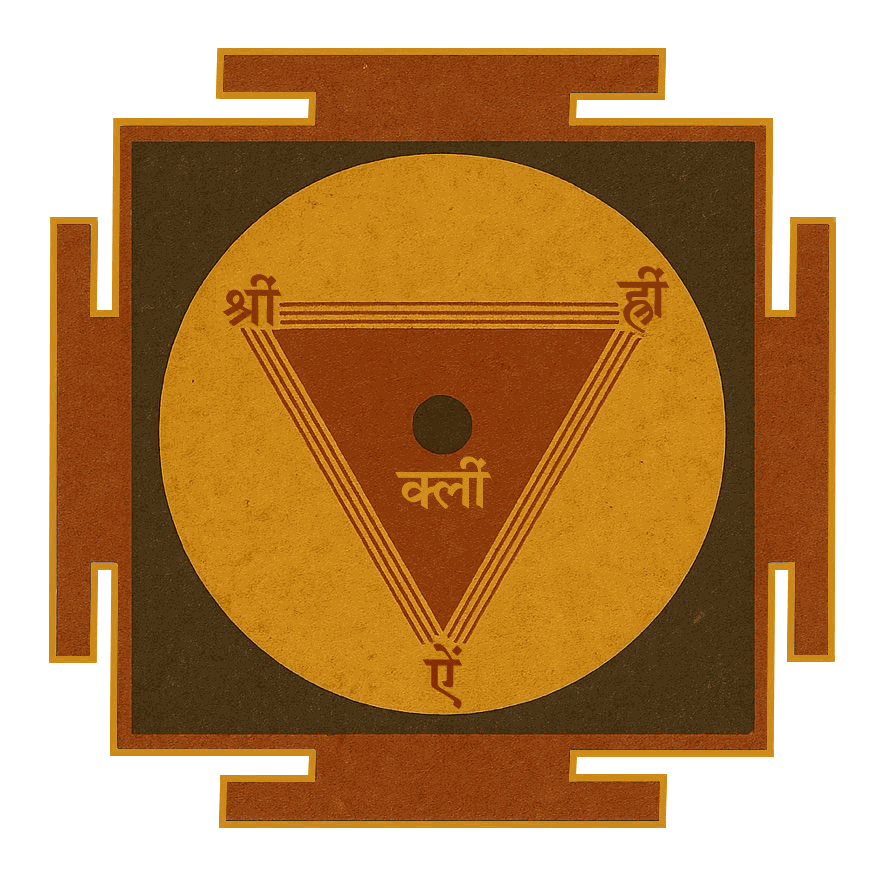
There are three aspects of Tantric teachings– Tantra, Mantra and Yantra– which usually go together. The Tantra is the teaching, which represents the reality we are seeking to realize. The Mantra is the sound-form of the deity, which is the power of consciousness that is the main propulsion towards realization. The Yantra is a geometrical design on which various mantras may be visualized and internalized.
Tantra affirms the importance of the body as a temple for Divine and grants it a sacred reality. It views our psycho-physical organism as a microcosm in which the individual soul can understand the workings of the entire universe. Tantra does not affirm ordinary bodily identity, but sees the body as a mystic symbol and hence Tantric Yoga looks upon the body as a temple for the Divine and as a mirror of the universe. On the other hand, ordinary people who affirm the body as the means to ultimate happiness end up abusing the body in order to achieve pleasures that are never really fulfilling anyway.
For the Tantric systems the body is the best vehicle nature can provide to aid us in our spiritual growth and is a great symbol for the different levels and powers of the cosmos. There is a natural intelligence in the body that shows us how to use it in the right way. This intelligence, which is part of the cosmic mind, reveals itself when we no longer use the body to pursue personal desires but as an instrument of developing higher awareness.
Traditional Tantra does not encourage mere emotional expression, which only causes greater attachment to emotions and through them to the outer world. Tantra regards emotions as trapped energy and seeks the release of that energy, in which the form of the emotion subsides like a wave into the sea of awareness. Tantra does not emphasize the personal expression of emotion but the understanding of emotion as a play of consciousness. Tantricism does not encourage suppressing anything that is natural to us, but discovering our true nature in which we can naturally let go all attachments and dependencies.
Tantra is associated with the worship of the Goddesses, the feminine aspect of Divinity, and this is one of its prime features. Tantra provides a whole spiritual science for the worship of the Divine Mother, not merely as a set of beliefs or dogmas but as a practical way of developing our higher awareness through Her wisdom and Her grace. Traditional Tantra gives reverence to both male and female powers and affirms that the God and Goddess go together, support each other, and should be worshipped together. Tantra views the feminine as the embodiment of wisdom and the energy of consciousness, and the masculine force as being, will and perception.
Kundalini literally means a coiled-up energy or the power that dwells in a Kunda. For any transformation to be possible, an energy is needed to bring it about and for the transformation of consciousness a special and powerful energy is needed; and that is Kundalini. Tantra presents a whole Yogic and Mantric science for developing Kundalini.
Tantra is a kind of science, a way of knowledge both for understanding the outer world and the inner psyche. Tantra is based on and closely allied with the various traditional sciences of India of which two most notable are Ayurveda and Astrology. In addition some modern scientists find the energetic concepts of Tantra to be similar to their own discoveries.
Tantra is allied with the alchemical traditions found throughout the mediaval world. In fact, much of what has been called alchemy is simply Tantra as a global tradition and in this regard, Tantra is nothing new, but the revival of old alchemical and hermetic approach. The Paths of Tantra (Tantra Marga)
Yogic traditions, usually contain two paths:
Path of Direct Awareness – formless meditational approach for direct realization
Path of Technique – whether meditational or ritualistic, for gradual realization
Tantra is primarily a form of the second path, The Path of Techniques. The first is represented in the Hindu tradition mainly by Advaita or non-dualistic Vedanta, which aims at the direct realization of the Self as Absolute. However, these two paths are not rigidly divided from one another and are integral parts of the same tradition. Tantra contains, as its higher teachings, direct approaches along the same lines as non-dualistic Vedanta, aiming at immediate Self-realization. Direct approaches also contain, as preliminary or support teachings, the use of techniques. The direct approach is best if we are truly capable of it, but it requires a higher level of spiritual maturity.
Right and Left-handed Tantra
Right-handed Path– Dakshinchara
Left-handed Part– Vamachara
The Right-handed path emphasizes meditational and spiritual disciplines and insists on a high degree of purity in conduct and action. The Left-handed path employs use of five forbidden elements (five ‘m’s). There are two main Tantric linage – the Samaya (according to the rule) and the Kaula (relating to Kula or according to the family/group). The Right-handed path follows the Samaya linage which refers to following strict dharmic principles and the Left-handed path follows the Kaula linage which allows local variations.
The Right-handed path is said to be for “Bhaktas” or those who have devotional temperament. The Left-handed path is said to be for “Viras” or those who have strong or heroic temperament, which refers to the warrior class. The Right-handed approach can be called orthodox. The Left-handed path allows unorthodox practices which may be outside both Hindu social dharma and the usual rules of Yogic practices.
Left-handed Tantra prescribes use of the five forbidden things. They are also called the five “M-s” or “Makaras”. They are: Maithuna– sexual union; Madya– wine; Mamsa– meat; Matsya– fish; Mudra– parched grains.
Partaking of these items is forbidden or restricted in the codes of conduct followed by most Vedic Hindu Yoga traditions in India, as such things are considered to have long-term tamasic or dulling effect upon the mind. Hence it is clear that their usage is a part of an exceptional path. Tantra, even of the Left-handed path, does not recommend their ordinary usage for self-enjoyment. While these substances are generally not accepted as pure, the act of offering the same to the deity purifies them and allows them to aid in spiritual growth.
Left-handed Tantra is itself divided into two traditions, the “Symbolic” and the “Literal” depending on whether the forbidden substances partaken of are actually physical or mere metaphors. The Symbolic Tradition uses he five forbidden things only as symbols.
Tantra aims at a personal relationship between us and the cosmic reality, which is to directly experience truth in our daily lives. Tantra teaches that consciousness is the sole reality in the universe. Hence all things can be approached and communed with as if they were conscious, because in truth they are. As part of consciousness each thing in the universe, including ideas, can be communed with and spoken to as if to another person. Ultimately, we must discover that all aspects of the universe are parts of our nature – which is not merely human, but the nature of transcendent Awareness.
Tantra is concerned with providing us tools to discover truth for ourselves rather than promoting dogma or ideology. Tantric tools consist of the whole range of spiritual practices, from rituals to formless meditational approach.
The Goddess or cosmic feminine force in Tantra is worshipped as Shakti, generally translated as “power”, whereas the God or cosmic masculine force is worshipped as Shiva, meaning “peace”. Shakti is the power of Shiva or the power of peace. It is not power born of violence or aggression. It is the power born in passivity, in silence of mind, the energy which comes from the void, like the life that comes forth from the womb. Shakti is not a power which asserted against something, but a power that enlivens everything from within. Shakti is the descent of Divine grace, which is the power of peace. Woman has the power and potency to create new life. She has the energy of beauty, delight and creativity. This transformative power of the Divine Mother is the Shakti that works behind all great changes in the universe, and brings the human being to the greatest transformation, which is enlightenment. The purpose of Tantra is to energize that Shakti dormant within us by unfolding all the different levels and rhythms of her movement, as she naturally seeks her native abode in the Supreme.
Shakti is not an external power but Svashakti, one’s own power. To worship the Shakti is to take back one’s own power, which is to recognize the power of one’s own consciousness, the womb in which the energy of enlightenment is born.
There are three aspects of Tantric teachings– Tantra, Mantra and Yantra– which usually go together. The Tantra is the teaching, which represents the reality we are seeking to realize. The Mantra is the sound-form of the deity, which is the power of consciousness that is the main propulsion towards realization. The Yantra is a geometrical design on which various mantras may be visualized and internalized.
The Mahavidyas have been known since the early mediaval period. The Mahavidyas are prominent primarily in Tantrik literature and in a few late sakta-puranas and upapuranas. The tantras contain little narrative material about the Mahavidyas. The tantras are primarily interested in providing the details of how to worship the Mahavidyas and do not dwell on the meaning of their symbolism or stories that feature them. In puranic literature, only a few late texts mention the Mahavidyas. They do, however, contain fairly detailed stories about the origin of the Mahavidyas as a group. These myths are important in providing interpretive contexts for the group as a whole.
The presence of Dashamavidyas on the Nilachal Hill at Kamrupa in Assam where the Kamakhya Temple is situated is unusual in the abundance and variety of images throughout the site. The Kamakhya Temple is an important sakta centre according to many texts, because it is the place where Sati's Yoni fell on the Earth, and hence her adi pitha. It is also strongly associated with Mahavidyas. Stone symbols inside the Kamakhya Temple represent the Sodasi, Matangi and Kamala. The other Mahavidyas have small temples located around the Nilachal Hill. The central representations of the Mahavidyas in these temples usually are not anthropomorphic and are sometimes difficult to see at all, as they are covered by flowers, clothing or offering and some of them are located in the underground caves.
Both literary and iconographic materials give the general impression that the ten Mahavidyas are different forms of an overeaching, transcendent female deity, who is usually reffered to simply as the Mahadevi. An underlying assumption of many sakta texts is that the highest reality is the Great Goddess, and this infinitely great being manifests herself in a wide variety of forms. The Mahavidyas might be understood as symbols of the stages of consciousness experienced by tantrik aspirants in their progressive spiritual development. Each Goddess confers a certain type of perfection, blessing, or awareness. These perfections or types of consciousness, meditative states or moods might be understood as progressive, some presupposing or being more inclusive than others. The Mahavidyas are approached in a variety of ritual contexts, and the worship of one Mahavidya may differ from that of others.
In Tantra, as in many spiritual traditions, the feminine aspect of Divine reality represents knowledge or wisdom. The true worship of the Goddess involves knowledge, which is her real form. It is not merely an outer worship, but an inner worship, which is meditation. Meditation on the Goddess is a form of Self-enquiry or a means of acquiring knowledge. It is not merely an adulation of feminine forms or qualities. It may start with the image of Goddess but reaches far beyond the limits of name, form and personality to the impersonal Absolute. The Goddess represents what is hidden, secret, subtle and sensitive, what has to be searched out and discovered. The Goddess represents what is to be known, what we are drawn by an inner fascination to discover. She is the mystery and allure of the higher knowledge which causes us to lose interest in what the mind can know, the familiar realm of the senses. The Goddess takes us beyond the realm of the known and the domain of time-space into the secrets of eternity-infinity.
The Goddess is not only knowledge but power and delight. Knowledge of her reveals her power, which is awesome and transformative. Understanding of her reveals her bliss, which is the joy of going beyond all the limitations of the body-mind. Wisdom is the ultimate form of beauty and delight, the most sought-after beloved object in creation, and hence the ultimate embodiment of the Devine feminine.
Spiritual knowledge is the womb through which we are reborn into the world of truth. The Wisdom Forms of the Goddess are part of a spiritual science, which we can examine only when we have set aside our outer knowing and its grasping for information and ideas. Each of the Ten Forms of the Goddess represents a particular approach to Self-realization, to knowledge of that within which transcends time and transient identity. Yet each of the ten has within itself many layers. Unless we are willing to look deeply, we may become caught in a secondary aspect of the form or function of the Goddess. The Ten Forms of the Goddess make up a complete and integral teaching but several of them have their own special worship as representing the Supreme Mother herself.
Kali is perhaps the most mysterious and difficult to understand of the Goddesses. The Sanskrit word Kali literally means TIME. Kali is the feminine of the word for time, which in the masculine is Kala.
Time is the foremost of the powers which governs the universe. In its essential nature time is eternity itself, perpetual changeless duration. This perpetuity or immutability in duration is the secret message of time. Time is being itself, the unborn, undying, absolute reality. Time in its manifestation conceals unmanifest time which is eternity, the mirror on which the images of time move but which they cannot effect. Time is the great force of change that drives all things to grow and develop. Hence this force of time is not a mere process of recurrence. Kali is the Goddess who symbolizes this spiral process whereby we grow and evolve into which goes beyond all form of change.
Time is not a mere abstract continuum in which things occur, it is a living field, a conscious energy, a matrix and a vortex. Time is the great womb and hence a feminine quality. Time is the mother who eats her own creations, which is one of the terrible aspects of Kali. Yet in devouring her own creation she is also returning them to the wholeness and delight.
Time is birth and death, growth and decay, which is the essence of our existence. Time is our life and hence we look upon it as our own. And yet we are afraid we will lose it. Kali teaches us that if we give up our attachment to the events of our lives, we gain mastery over time. Time draws us to attach ourselves either to the forms of time or to the being of time which is eternity. Time is either beguiling us to pursue some experience, or educating us to merge into the ground of experience itself which is the eternal presence.
For our spiritual re-creation or resurrection, we must first allow the attachment to our material nature to be destroyed. We must go beyond all the bonds of the known and determined, relinquishing all identities, opinions and beliefs. We ourselves must become sacrificial victim to the Divine. Only the sacrifice of our own ego can really deliver us beyond the bonds of ignorance and sorrow. Kali is the form of Divine energy that accepts this offering.
Not only do we exist in time, we are part of time and partake of its essential nature, which is eternity. Not only we do experience change in our outer nature through the mind-body complex, in our inner nature as pure consciousness we witness change from the standpoint of the timeless. As we grow in consciousness, we become the time itself. Time is life. Life is the movement in time. Through our own life-force or Prana, we experience time. Kali as the time is Prana or life-force. She is the secret power behind the working of our bodily systems and vital energy.
The life-force manifest through blood. Hence Kali is associated with blood. As the life-force she drinks the blood of all beings. She is life ever renewing itself through our various physiological processes, which are all various sacrificial offerings of matter to the spirit.
Time is our eventual death and the destruction of all things. Hence Kali is also Death. Yet death is not merely annihilation but the doorway to the eternal. Death is merely the ending of what has no real substance, which our ego and attachment to the material nature. It eliminates the inessential to reveal the essential. Spiritual death, the death of the separate life, is the way to eternal life.
Life and death are the rhythm of time, the ebb and flow of the eternal sea. Kali is the life in death and the death that exists in life. To be conscious of life in death and death in life is one of her meditational approaches. To die daily is her daily worship. This is to die to all the things of thought, our worries, cares, anxieties, ambitions, loves and hates, likes and dislikes. It is to daily cast our minds into the highest flame of the fire of awareness.
Life or Prana is the manifestation in creation of the eternal principle of Being, Sattwa. Our desire to live forever reflects our eternal being, Kali grants us this eternal life and yet this eternal life has a price. To gain the eternity that is Kali, our mortal nature must be sacrificed. Hence Kali appears frightening and destructive to the ordinary vision.
Yet we all must die. We must lose our attachments, including our own body and mind. Our clinging to things has never allowed us to hold on to them anyway. It has only bred frustration because we lose them eventually. Hence the sacrifice of the mortal nature is something that is inevitable. If we do it voluntarily we gain immortality (not physical). If we are forced to do it involuntarily, we fall into the confusion of repeated births(within the lifespan), in a vain attempt to satisfy our unfulfilled desires.
Kali is located in the Heart Chakra (Anahata Chakra) of the subtle body, the seat of the air element or vayu. Kali relates to the physical heart also, which circulates the life-force, and to the blood itself which carries the life-force.
Tara is not only an important Hindu Goddess, she is also the most important of the Buddhist Goddeses. The bodhisattva Tara is consort of the great Buddha Avalokiteswra, the Lord who looks down with compassion on all living being. In the Chinese Buddhist tradition she is called Kwan Yin. Among the Dasamahavidya Tara resembles Kali and is her first transformation. Time and life are related to the sound current or Divine Word, which is Tara. Tara is the power of sound (Shabda Shakti), corresponding to Kali as the power of time and transformation. The Word (Shabda) is the consciousness of time, whereas time is the movement of the Word. The Word is the intelligence of time, whereas time is the body of the Word. The creative vibration or the Divine Word is the underlying energy of time. The term Tara means the deliverer or savior, from the Sanskrit root "tri", meaning "to take across", as to take across a difficult situation.
The Divine Word in both Hindu and Buddhist systems relates to the mantra OM. Om is the power of sound, called Pranava or the origin of vibration. Tara is the Vedic name for Om or the Lord Shiva, who in the Vedas is also known as Rudra or the resounder, relating to the transformative power of the Divine Word. Om is called Tara or Taraka, the deliverer because, like a boat, takes across (tarati) the ocean of ignorance.
Tara is the feminine form of Om or Om personified as a Goddess. Tara is the unmanifest sound that exists in the ether of consciousness, through which we can go beyond the entire manifestation. According to Patanjali Yoga Sutras, Om is the voice of Ishvara. Om pervades all other mantras. Only through their connection with Om can other mantras be effective or be understood in their specific nature. Tara is perhaps the most important Goddess of mantric knowledge, the very personification of Mantra Shakti. Tara gives poetic and oratory powers to her devotees, and should be worshiped by those who seek these capacities. One devoted to Tara, it is said, can never be defeated or debated in the display of literary talents.
Tara is the purifying force of the vital breaths. Sound that manifests in the ether is the same as the Prana(life-force) that manifests in the ether. Breath is the primal sound of life, and the sound of the breath is the original, spontaneous and unuttered mantra (So'ham). Both mind and Prana, as word and vibration, have their root in sound. Hence the use of sound or mantras both purifies and energizes the mind.
Tara is the radiance of knowledge that arises from the differentiation of meanings through sound. Different sounds serve as vehicles whereby different ideas or meanings flash forth. All meanings exist to reintegrate us into the ocean of meaning that is pure consciousness itself.
All knowledge is a striving towards the infinite and the eternal, an attempt to link us back to some greater reality. This inherent aspiration of Tara hidden in our speech and our thought is ever seeking to move us beyond the realm of the known. Tara relates specifically to the third of the four stages of speech, Pashyanti, the state of seeing, the perspective or illumined word. Tara is the Goddess of Consciousness itself.
Tara is the consort of Brihaspati, the Vedic lord of Wisdom, who is the Lord of manifest sound. As an abode of speech, Tara relates to the tongue. In Sanskrit, tongue (Jhivva) is a feminine term. On a mystic level tongue relates to Agni(fire) or the speech powers of Cosmic Being (Purusha).
Tara has a wrathful or terriblem form, which is called Ugra Tara. In this capacity she is dark blue in colour and is also called Nila Sarasvati.
Tara relates to the Manipura Chakra (Naval Chakra), which is the centre for the third or illuminated stage of speech (Pashyanti) Her other centre is the Tongue. She is the rising sound current that leaps upward from the naval. As Om or the Guru, she relates to the Angya Chakra (Third Eye/Trinetra). She is thus the rising current of sound from the Naval Chakra to the head.
The feminine nature is synonymous with beauty. Tantra asks us to search for the source of beauty, it says that the highest beauty is not on the outside but in the inside. External beauty can only reflect for a moment and the internal beauty transcends all forms. True beauty is eternal and merely reflected onto the changing forms of things.
Tripura Sundari is not the ordinary beauty. The highest beauty does not lie in any object, though it is not apart from objects. Beauty derives from the light of consciousness that is irradiated through objects. It is never contained in any object. The light of beauty we see in things is the light of our own awareness. Discovering this we contact the springs of infinite delight within us.
The beauty of perception occurs when the mind is cleansed from the known, when consciousness is cleared of its conditioning and rests in pure awareness without any residue of memory. Tripura Sundari represents the ultimate beauty of pure perception which arises when we see all the universe in ourselves, when we see all the nature as a reflection of reality of consciousness. Tripura Sundari is the beauty of nature seen through a spiritual eye of unity through the revelation of our own eternal and infinite Self in every moment of perception. When the mind is permeated with such unlimited awareness it finds a plenary delight in everything that we see. It finds perception to be joy, even if we are looking at the most ordinary things.
Beauty and bliss is the fundamental energy of existence, and its interplay is the nature of all manifestation. Knowing this we can easily free ourselves from attachment and find happiness and delight in whatever life may bring to us. This insight is a part of knowledge of Tripura Sundari.
Tripura Sundari is also called Rajrajeswari.
The word Tripurs means - Tri is three and Pura is citie. The three cities are the Three Worlds and our Three Bodies through which we experience them - the physical, astral and casual or matter, energy and thought. Tripura corresponds to the three states of consciousness - waking, dream and deep sleep. Tripuras are symbolized by the three lights of fire, moon and sun. The being who delights in these three world experiences, yet inherently transcends them, is Tripura Sundari.
Her first city is the walking state wherein our consciousness dwells in the eye (the senses). Her second city is the dream state, which occurs in the Throat Chakra, wherein our consciousness dwells in the mind. Her third city is deep sleep, which occurs in the heart, wherein our consciousness returns to true nature. As the ruler of the three, Sundari is the mystic fourth, the state of Turiya or Samadhi.
Tripura Sundari is often represented as a young girl of sixteen years age. In this form she is called 'Shodasi' or 'Bala'. At this stage of woman's life the delight aspect of her existence is most pronounced. Her nature is to play, to seek new experience, and to charm others to her. Her innocence attracts to her all this that is true and good.
Tripura Sundari is located in the Shahasra Chakra (Crown Chakra), the abode of the immortal nectar (amrit).
Bhuvaneshvari means the Goddess Ruler (Ishvari) of the universe (Bhuvana). Bhuvaneshvari is known in the Vedas as Aditi, the infinite or invisible mother, the great origin and cosmic womb, who is space. She is the Mother of the Sun and all the Sun Gods who are named after her (Aditya).
The Mother creates space (in her cosmic womb or Hiranya Garbha) in order to give birth to all things. Similarly, She creates space within our own consciousness to give birth to the Divine nature within us. Space has many levels of manifestation. There is not only space of the physical universe but also the space of the mind. There are many additional layers of space in the higher levels of the mind. Ultimately, there is the supreme space of pure consciousness beyond all manifestations.
In the microcosm or our own body, the entire universe is contained in small space that dwells within the heart. The heart is where the infinite space hides within us, and is the real seat of the Divine Mother Bhuvneshvari. Bhuvaneshvari represents space. Space is the Mother or matrix in which all creatures come into being. She is the field where all things grow. She is the receptive spirit who gives space to allow all things their place and function. She is the cosmic womb or Hiranya Garbha that gives birth to all worlds.
Space is the primal matter which is the root of all the elements. The gross elements, like earth and water, are merely dandified or concentrated space, as modern Physics has revealed. As the root substance of the universe the Goddess is called Prakriti, the primal substance, or Great Nature. We live and move within the substance of the Goddess who is Bhuvaneshvari, the Mother Nature personified. This primal space is consciousness and hence cannot disturb or weigh us down, but is the very expression of freedom and joy.
As the power that measures out the universe, Bhuvaneshvari is called Maya, which also means illusion. When things are measured we can become caught in their limited forms and forget the underlying unitary pace in which they appear. This is how illusion arises. All manifest forms are merely waves in the infinite space of the Divine Mother. We must learn to see the space of the Mother, which is the embrace of consciousness, in all the apparent objects of the world, and no longer take their diverse forms as reality. Consciousness in the field in which all objects occur and without which they have no meaning. Grasping that field we can possess all objects, the entire universe itself.
Bhuvaneshvari is located at Spiritual Heart Center (on the right side of the chest), which is the seat of Self-awareness.
According to the Zuni Indians of North America, all spiritual phenomena falls into two categories: the Beautiful and the Dangerous. These are mutually exclusive. The beautiful and the terrible often go together.
Bhairavi represents the supreme power of speech, which has the nature of fire (Tejas).She is the Word in its unarticulated and primal form as raw energy. She is the supreme light and heat power, the flame of consciousness itself (Cidagni) which is the ultimate knowledge of truth. Bhairavi as Tejas rules over the Tanmatras, the subtle sensory potential behind the five elements and five sense organs which allow for the interconnection. Through the Tanmatras Bhairavi gives power over the senses and the elements.
The fierce form of Divine Energy exists within us as the power of transforming heat (Tapas). Tapas is sometimes translated as ascetism. More properly it is a heightened aspiration that consumes all secondary interests and attachments. When we are really interested in something we naturally lose our attraction to other things. Tapas is the real interest and profound absorption in the spiritual life that causes us to no longer want anything else. Tapas is the heat of spiritual inquiry and aspiration which causes us to discard all that is non-essential in life.
Bhairavi dwells at the base of the spine in the Muladhara Chakra (Root Chakra). She is same as Kundalini, most specifically in her awakened role as the purifier of our nature.
To lose one's head over something is a common expression for becoming totally engrossed in something to the extent that we lose our ordinary sense of reality. To be without a head is a yogic metaphor for going beyond body consciousness or attachment to the thought-composed mind. The spiritual path is aimed at opening the lid of the mind so that we can have access to the universal consciousness beyond thought.
Actually, we don't really see our head, we experience the inside of our head primarily as an open space. Hence, we really don't have a head, except to the extent that we imagine our bodily form from our mirror image. According to the science of Yoga this headless state is our true reality as a conscious perceiver.
Chhinnamasta, whose image is a severed head, is the Goddess who causes us to cut off our own heads or to dissolve our minds into pure awareness. She brings transcendence of the mind and represents the non-mind (unmana) state. Freed from the limitations of the mind, consciousness realizes its true nature beyond death and sorrow. Hence, we need not fear losing our bodies or losing our head, death will take them anyway. In fact, the only way to real awareness is to sacrifice the mind, to give up the thought mechanism based on the Self-image. The mind sacrifice is symbolized by the cutting off the head. It indicates the discrimination of the mind from the body, the freeing of consciousness from the shackles of body consciousness. Once this is done our consciousness will no longer be confined within the body.
It is a frightening and even physically painful which removes us permanently from the realm of ordinary human experience. Even the initial stages of this process can cause much doubt and anxiety as we see our ordinary identity taken away from us. The pain of the ego-sacrifice is something that no one wants to experience, even once we recognize its necessity. It causes a total reorientation of our energies which is like being reborn.
Chhinnamasta- which literally means "a severed head" - is perhaps the most frightening form of the Goddess. She has cut off her own head and, holding it in her left hand, with it drinks the blood flowing from her own severed neck. What she represents is the joy of transcending the body, not the pain of losing it. Consciousness is not limited to the body. It is a sphere of perception that dwells in the head but can function on its own apart from the body. In the body, consciousness is confined to the limited realm of the senses and their outward grasps. Liberated from the body, consciousness has the vision of infinity which includes the entire universe in itself.
According to Yogis Science there are three Granthis(knots) which prevent the movement of energy from flowing up the Sushumna nadi of the subtle body. These are the Brahma-granthi in the Muladhara Chakra (Root Chakra) which represents our bondage to speech, the Vishnu-granthi in the Anahata Chakra (Heart Chakra) showing our bondage to emotion, and the Rudra-granthi in the Angya Chakra (Third Eye/Trinetra) showing our bondage to thought. Chhinnamasta represents the piercing of the Rudra-granthi allowing us to transcend thought, the mind and body consciousness together. Chhinnamasta thus represents the free flow of energy through the Sushumna. She is the Kundalini Shakti flowing upward from the base of the spine to burst open the Sahashra Chakra and stream out into the infinite.
Chhinnamasta relates to the Angya Chakra (Third Eye/Trinetra), which is her chief place of action. She represents the opened Third Eye from which comes the lighting of direct perception that destroys all duality and negativity. As the upward movement of the Prana she is related to Udana Vayu, the upward moving vital air, which the yogis seek to develop.
Dhuma means, "smoke". Her nature is not illumination but obscuration. By obscuring all that is known, Dhumavati reveals the depth of the unknown and unmanifest. Dhumavati obscures what is evident in order to reveal the hidden and the profound. Dhumavati is portrayed as a widow. She is the feminine principle devoid of the masculine principle. She is Shakti without Shiva as a pure potential energy without any will to motivate it. Thus, she contains within herself all potentials and shows the latent energies that dwell within us. To develop these latent energies, we must first recognize them.
Dhumavati shows the feminine principle of negation in all of its aspects. On an outer level she represents poverty, destitution, and suffering, the great misfortunes that we all fear in life. Yet on an inner level this same negativity causes us to seek a greater fulfillment than can be achieved in the limited realms of the manifest creation. After all, only frustration in our outer life causes us to seek the inner reality.
Dhumavati represents the darkness on the face of the deep, the original chaos and obscurity which underlies creation. She is the darkness of primordial ignorance, Mulavidya, from which this world of illusion has arisen, and which it is seeking to transcend. The truth is that we are born in ignorance. It is not some theory but the hard and clear fact of our existence. We don't really know who we are or where we are going in life. Our life is limited between these two greater darkness's. Hence Dhumavati or smoke embraces us on both sides.
Ignorance has a higher meaning. Only when we recognize that we are ignorant, that we really don't know anything, we can begin to learn. Moreover, as we grow in consciousness, we recognize that the ordinary mind has no real capacity for true knowledge, that true knowledge only begins when we set the ordinary thought process aside. It is not so much that we do not know as that what we call knowledge can never take us to the truth. For yogis this higher ignorance means ignoring or forgetting the movements of the mind, letting go off all fears, desires, likes and dislikes, opinions and beliefs. By no longer recognizing any reality outside of consciousness we go beyond the field of death.
Dhumavati is the primal sleep wherein all the creatures of the universe are dissolved in the underlying reality of the Supreme Brahman. She is also Yoga-nidra in which the yogi is merged into the pre-creation state of consciousness and no longer perceives the external world. Dhumavati represents the negative powers of life : disappointment, frustration, humiliation, defeat, loss, sorrow and loneliness. Such experiences overpower the ordinary mind, but to the yogis they are special doors of opportunity to contact the reality which transcends desire. Dhumavati reveals the imperfect, transient, unhappy and confused state of ordinary egoist existence in order that we may transcend it.
Dhumavati relates to the heart.
Beauty can have stunning effect on us, beauty can cause us to lose our senses and become dumbstruck. The cosmic feminine power has a capacity to stunt, stop or paralyze. These are the aspect of Bagalamukhi, who represents the hypnotic power of the Goddess. Bagala means literally "rope" or a "bridle" and Mukhi means "face".
Bagalamukhi is a Goddess of speech, and as such is related to Tara and regarded as a form of her. When sound becomes manifest as light, Tara becomes Bagala. When the brilliant light of speech comes forth, then Tara gains the effulgence of Bagala and causes all things to become still.
The weapon that puts an end to all conflict and confusion is the weapon of spiritual knowledge, the Weapon of Brahman (Brahmastra). The highest form of the Brahmastrs is the question "Who I am ?" or "What is the Self ?". If we look deeply, we see that, though we may know external things, our Self remains unknown to us. What we call our Self is merely some temporary thought, emotion, or sensation with which we are identified, but not the nature of our consciousness itself. If we continually bring the mind back to this question, "Who am I?" it will put an end to all our wandering thoughts and make all other questions and seekings appear unimportant. This is how Tara or Om the Divine Word, becomes a force of inquiry to bring us to stillness or to power of Bagala.
Many Tantric Yogis aim at developing the power of Stambhana, which literally means "stopping" or "paralyzing". On an outer level it portrays a different meaning, on the inner level (actual level) it is the mastery of our own negative thoughts and energies. Negativity is not so much a force that has to be destroyed as a distracted state of mind, but that must be brought to rest.
Bagala grants complete control over our movements and the capacity to stop them at will. Such stopping comes from and promotes self-awareness. It develops detachment as it prevents us from becoming identified with what we do. To promote this awareness, we must learn to stop and observe ourselves during ordinary daily activities. We can literally stop ourselves in mind motion to observe our state of mind when we are busy, engaged and disturbed. Or we can continue with our actions but keep our mind in the quiescent state of the observer.
Bagala turns each thing into its opposite. She turns speech into silence, knowledge into ignorance, power into impotence, defeat into victory. She represents the knowledge whereby each thing must in time become opposite. As the still point between dualities she allows us to master them. We contact her grace when we see the opposite hidden in each situation and are no longer deceived by appearances. To see the failure hidden in success, the death hidden in life, or the joy hidden in sorrow are the ways of contacting her reality. Bagala is the secret presence of the opposite wherein each thing is dissolved back into the Unborn and the Uncreated.
Bagala relates to the soft palate, the place called Indra-yoni, which is the middle point between the senses of eyes, ears, nose and the tongue. The soft-palate is related in function with the Third Eye, and so Bagala, like Chhinnamasta is associated with the Angya Chakra. Concentration on the point of the soft-palate gives control over the senses and vital energies (Pranas).
Bagala also relates to Anahata Chakra as the prime site of Prana.
Mata literally means "a thought" or "an opinion". Matangi is thus the Goddess power which has entered into thought or the mind. She is the word as the embodiment of thought. She also relates to the ear and our ability to listen, which is the origin of true understanding that forms powerful thoughts. Matangi bestows knowledge, talent and expertise. She is the Goddess of the spoken word and any outward articulation of inner knowledge, including all forms of art, music and dance.
Matangi resides in the Visuddha Chakra, the centre of speech. She also resides on the tip of the tongue, the place wherein speech is articulated and wherein we are able to taste the essences of light.
The Lotus is the most sacred flower. The Lotus is a symbol of enfoldment : it represents the opening of the lotuses of the different charkas of the subtle body, particularly the lotus of the heart. Though the lotus puts its root into the mud and grows in marshlands, it produces the most beautiful flower, like soul coming forth from the earth of the physical body. Kamalatmika is one whose nature is of the lotus. She is sometimes just called Kamala, which is one of the many Sanskrit names for lotus.
Kamala is the form of the Goddess most worshipped by people in this world, as we are mainly cognizant of outer beauty and abundance. Most of us are engaged in pursuit of pleasure, fortune, talent, fame and so on, which are nothing but superficial or limited aspects of the power of Kamala. Since we naturally pursue Kamala, we might as well pursue her higher form. The most beautiful thing in life is devotion of the Divine. When we have the spirit of devotion for the Divine presence everywhere we find incomparable beauty and wealth in everything.
Kamala relates to the beauty of perception whereby we see the Divine quality in each thing. The quality of our consciousness is our greatest wealth, not what we possess outwardly, which we can never really hold onto anyway.
Kamala is located in the Anahata Chakra.
As they constitute a complete system of knowledge, there are a number of ways to correlate the Dasamahavidyas. Generally, they fall into two groups of five. The first five represent the prime principles of existence.
| Name | Association |
|---|---|
| Kali | Time |
| Tara | Word |
| Tripura Sundari | Light |
| Bhuvanesvari | Space |
| Bhairavi | Energy |
| The next five represent the main methods of transformation in the practice of Yoga. | |
| Chhinnamasta | Perception |
| Dhumavati | Voidness |
| Bagalamukhi | Stillness |
| Matangi | Knowledge |
| Kamalatmika | Delight |
| These two groups go together: | |
| Kali-Chhinnamasta | Time and transformation |
| Tara-Matangi | Word, unmanifest and manifest |
| Sundari-Kamala | Beauty, unmanifest and manifest |
| Bhuvanesvari-Dhumavati | Space, manifest and unmanifest |
| Bhairavi-Bagalamukhi | Energy, in motion and in stillness |
However, we should recognize that these terms have deeper meanings. Time to the yogi is not an abstract concept but the energy of eternal life. Space is not a mere vacuum but the presence of eternal love. The Word is no mere sound but the cosmic creative vibration. Light is the illumination power of consciousness itself. Energy is not a mere blind force but the very surge of Divine glory.